
Heating and cooling systems rarely fail without warning. Behind most breakdowns is a history of building conditions that forced the HVAC system to work harder than it was designed to. Restricted airflow, deteriorating duct connections, and insulation gaps accumulate over time and place sustained stress on equipment long before a repair call becomes necessary. An energy audit identifies those conditions early, giving homeowners a documented picture of exactly where their home is losing performance and what corrective work will restore it.
Climate Pros Inc serves homeowners across Macomb and nearby Michigan communities with professional HVAC services, including system inspections, targeted HVAC repair, and full equipment replacement. Our team works alongside the findings that energy audits produce, translating building performance data into accurate, actionable service. As a locally rooted HVAC company, we bring Macomb-specific knowledge to every evaluation, from the extended heating loads that Michigan winters impose to the lake-effect moisture conditions that accelerate wear on residential equipment throughout the region.
Purpose of a Home Energy Audit
An energy audit is a formal evaluation of how a home uses and loses energy. A certified energy auditor (a professional trained and credentialed through programs such as BPI or RESNET) inspects the building envelope, insulation, ductwork, and mechanical systems to identify where energy escapes and where performance falls short.
The process relies on diagnostic equipment rather than visual estimates. Two tools are central to most residential audits.
Blower Door Test
A blower door is a calibrated fan mounted in an exterior door frame. It depressurizes the home to a controlled pressure and measures how quickly air infiltrates through the building shell. The test quantifies total air leakage across the whole house and, when combined with airflow mapping, identifies specific leak locations around windows, outlets, plumbing penetrations, and unsealed framing gaps.
Duct Leakage Test
A duct leakage test pressurizes the duct system (the network of metal or flexible channels that distributes conditioned air from the HVAC equipment to individual rooms) and measures how much air escapes before reaching its destination. High duct leakage means the HVAC system produces conditioned air that never reaches the living space, forcing longer run cycles to compensate.
Both tests produce measurable numbers. The results tell a certified auditor exactly how airtight the building is, how much conditioned air the duct system loses, and where insulation levels fall below current standards.
Energy Audit Findings and Home Performance
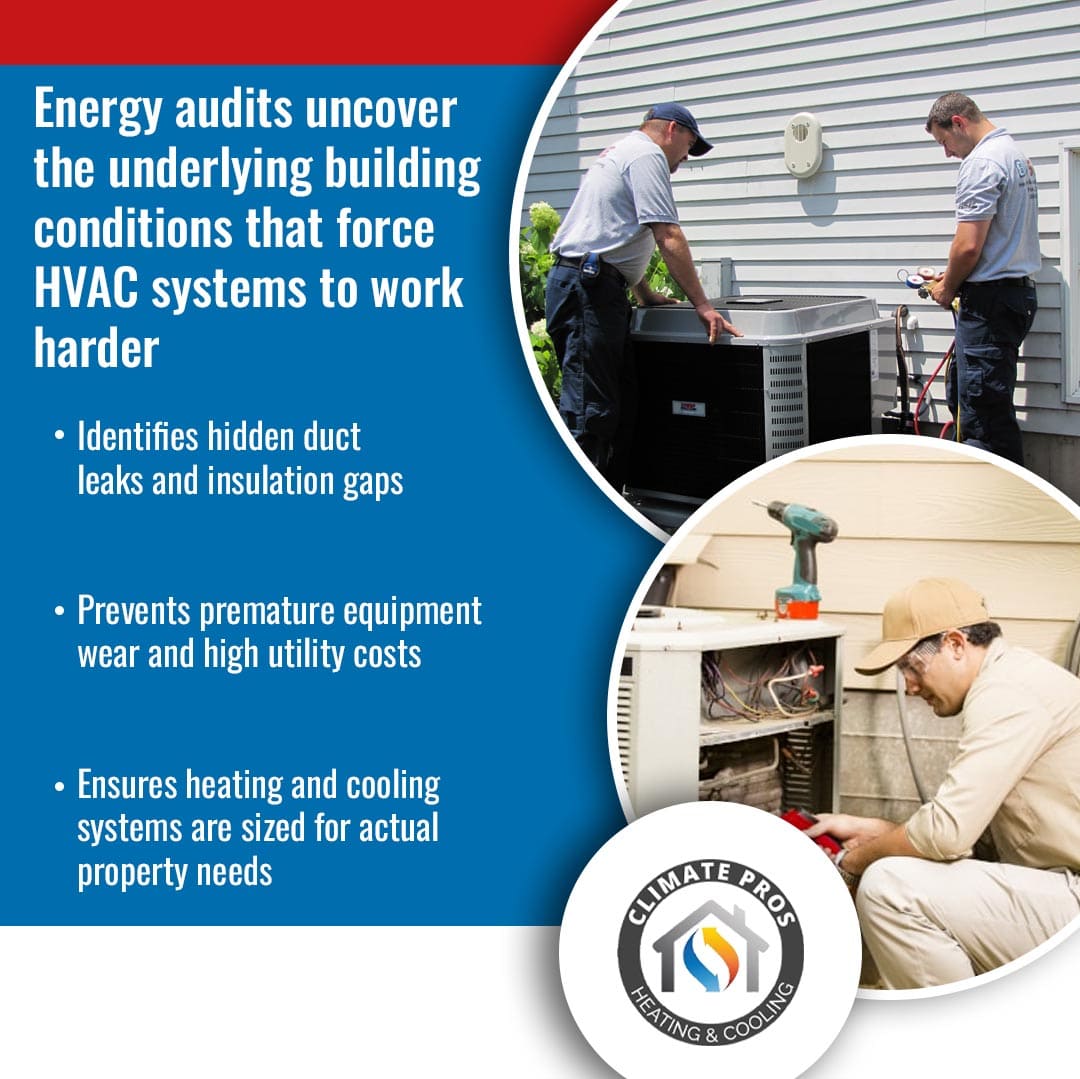
An audit does not diagnose HVAC equipment failure. It diagnoses the conditions the equipment is working against. Those conditions directly affect how hard the system works, how long it runs, and how evenly it distributes conditioned air throughout the home.
Air Leakage and the Building Envelope
The building envelope is the boundary between conditioned interior space and the outdoors. It includes the walls, ceiling, floor, windows, and doors. When the envelope leaks, outdoor air enters and conditioned air escapes continuously, regardless of whether the HVAC system is running properly or not.
Gaps around recessed light fixtures, attic hatches, electrical boxes, and where walls meet floors or ceilings are among the most common leak points in Michigan homes. These gaps are often small individually, but collectively they add up to the equivalent of leaving a window open year-round. The blower door test puts a measurable number on that total leakage.
Insulation Deficiencies
Insulation is measured in R-value, which refers to a material’s resistance to heat transfer. A higher R-value means better thermal resistance. Attic insulation is one of the most frequent and impactful deficiencies found in Michigan homes, because heat rises, and an attic with inadequate insulation allows a large volume of heated air to escape directly through the ceiling during winter.
Homes built before 1980 commonly carry insulation levels below the current Michigan energy code minimums. An audit documents R-values across the attic, walls, and crawlspace and identifies where additions would reduce the heating and cooling load placed on the HVAC system.
Duct System Losses
The duct system connects the HVAC equipment to every room in the home. Leaks at duct joints, deteriorated flexible connections, and uninsulated duct runs through unconditioned spaces like attics or crawlspaces all reduce the volume of conditioned air that reaches its intended destination.
According to ENERGY STAR, in a typical house, about 20 to 30 percent of the air moving through the duct system is lost due to leaks, holes, and poorly connected ducts. That loss shows up as rooms that never quite reach the set temperature, uneven comfort across the home, and an HVAC system that runs longer than it should.
Equipment Sizing Mismatches
An audit also evaluates whether the installed HVAC equipment is correctly sized for the home’s actual load. Equipment sizing is calculated using a Manual J load calculation, an industry-standard method that accounts for square footage, insulation levels, window area, local climate data, and building orientation.
An oversized system short-cycles, meaning it reaches the thermostat set point quickly and shuts off before completing a full air distribution cycle. This leaves humidity unaddressed, produces uneven room temperatures, and places repeated mechanical stress on components despite the equipment being relatively new.
Once these conditions are documented, the next step is connecting the findings to a qualified HVAC company near you that can act on them with accurate, targeted service.
The HVAC Company’s Role After an Energy Audit
An energy audit produces a written report. That report is most useful when the HVAC company reviewing it has the regional experience to translate findings into targeted service. Three areas of follow-up work consistently emerge from residential audit reports in Michigan.
Duct Sealing and Airflow Correction
When an audit identifies duct leakage above acceptable levels, the technician addresses it by sealing accessible joint connections with mastic (a flexible sealing compound used on duct joints) or metal-backed tape, and insulating duct runs that pass through unconditioned spaces. The result is less conditioned air lost before it reaches the living space.
Where insulation gaps are the primary finding, a technician advises the homeowner on sequencing, since air sealing should precede insulation additions for the best outcome.
Thermostat, Refrigerant, and Airflow Adjustments
Audit findings related to thermostat placement, refrigerant charge, or airflow often point directly to HVAC repair work. A thermostat positioned near a drafty window or in direct sunlight produces inaccurate temperature readings and causes the system to cycle based on false data. Repositioning or recalibrating the thermostat is a straightforward adjustment that produces measurable improvement in distribution accuracy.
Refrigerant charge discrepancies (where the refrigerant level in a central air or heat pump system is slightly off) cause the system to underperform on hot days without triggering an obvious failure code. This condition is only detectable through direct measurement by a licensed technician, and audit findings give the technician a documented starting point.
Equipment Replacement Based on Load Data
When audit findings include a Manual J result showing that the installed system is oversized or undersized relative to the home’s actual load, replacement becomes a data-driven decision rather than a reactive one. Rather than matching the size of the old unit, HVAC installers working from audit data select replacement equipment based on what the home actually requires.
A common replacement error is installing new equipment at the same capacity as the old unit, even when the old unit was the wrong size to begin with. Working from verified load data breaks that pattern.

Michigan Climate Conditions and Audit Relevance
Michigan’s climate produces conditions that accelerate equipment wear and building performance loss at a rate that national benchmarks do not fully reflect. Homeowners in Macomb County face region-specific factors that shape how audit findings should be interpreted and what follow-up work they typically call for. Addressing those findings accurately starts with an HVAC company near you that understands the local conditions driving them.
Extended Heating Season Load
Macomb County’s heating season runs four to five continuous months, placing hundreds of operational hours on residential heating equipment before spring arrives. Duct connections, insulation, and equipment components all show more cumulative wear than national averages suggest. Building deficiencies that a shorter heating season might obscure become visible here.
Lake-Effect Moisture and Corrosion
Lake-effect weather patterns push elevated humidity across southeastern Michigan throughout winter. Corrosion on outdoor coils, electrical connections, and unit housings develops faster in communities like New Baltimore, Chesterfield, and Shelby Township than national maintenance guidelines account for. HVAC services in Macomb delivered by technicians familiar with these regional patterns produce more accurate assessments than those based on generalized guidance.
Freeze-Thaw Cycle Effects
Repeated cycles of freezing and thawing shift soil beneath outdoor unit pads, which can tilt units off level, affect condensate drainage, and stress duct connections in homes with below-grade duct runs. Experienced HVAC installers working in Macomb recognize these effects during inspections and address them as part of standard service.
Connecting Audit Results to HVAC Services in Macomb
The value of an energy audit depends entirely on what follows it. A report that identifies duct leakage, insulation gaps, and thermostat issues without triggering corrective work does not improve comfort. The practical outcome comes from a locally rooted HVAC company near you that can review those findings, schedule any necessary HVAC repair, and address each issue with regional accuracy.
How Climate Pros Inc Approaches Audit Follow-Up
At Climate Pros, our team works with homeowners across Macomb and nearby Michigan communities to address exactly the conditions that energy audits surface. Whether that involves duct sealing, equipment recalibration, targeted repairs, or a full system replacement sized by HVAC installers working from verified load data, we deliver professional results and honest assessments on every job.
Climate Pros treats every customer like family, and that means giving straightforward recommendations based on what the findings actually show, not on what drives the largest service ticket.
Our technicians know Macomb County homes. They understand the wear Michigan winters place on residential equipment, the building conditions common to the region, and the follow-up work that audit findings typically call for here. That regional knowledge translates directly into faster diagnostics and more accurate service on every visit. Repairs are targeted to the documented issue. Replacements are sized to the home’s actual load by our HVAC installers, not to whatever was installed before. Every step follows the data.
Schedule Your HVAC Evaluation With Climate Pros
Climate Pros Inc provides professional HVAC services in Macomb built on one standard: professional service, professional results. Our work covers system inspections, HVAC repair, seasonal maintenance, and full equipment replacement, each handled with the same level of care, regardless of the size of the job.
Call us at (810) 794-2200 to schedule your evaluation. We serve homeowners in Macomb, Shelby Township, Washington Township, Chesterfield, Utica, Romeo, New Baltimore, Richmond, Rochester, and nearby Michigan communities.